Hold on I See a Dog
Let’s be real: when you’re choosing a machine embroidery design for a client’s custom tote bag—or stitching up a batch of baby onesies for your Etsy shop—you don’t just need “cute.” You need clarity, confidence, and craft integrity. That’s why I spent last Tuesday stitching Hold on I See a Dog onto a heavyweight cotton canvas tote, then again on a soft French terry sweatshirt, then once more on a lightweight linen tea towel. Not because it’s flashy—but because it’s the kind of T-Shirt Designs graphic that quietly asks, “Does this hold up?” And after three real-world runs? Yes—but with nuance.
A First Stitch Tells You Everything
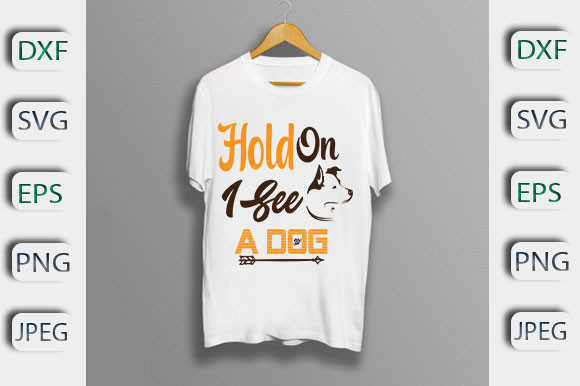
The moment I opened the folder—EPS, SVG, PNG, DXF—I didn’t go straight to the embroidery software. I printed the PNG at actual size and held it up to natural light. Hold on I See a Dog has an easygoing charm: friendly lettering with subtle bounce, a compact silhouette of a dog mid-perk (ears up, head tilted), and clean negative space around the phrase. It’s not overly detailed, but it’s not lazy either. There’s intention in the curve of the “o”s and the slight asymmetry of the dog’s snout—just enough personality to feel handmade, not algorithmic. As a Graphics asset, it reads well at 3.5" wide—the sweet spot for chest embroidery on adult tees or center-front placement on toddler sweatshirts.
Where It Shines—and Where It Needs Care
This isn’t a one-size-fits-all embroidery file. It thrives on stable, medium-weight fabrics: canvas totes, brushed cotton sweatshirts, denim aprons, and even structured pillow covers. On those surfaces, the stitch density feels balanced—no heavy fill stitch flooding the letters, no fragile satin stitch edges collapsing under hoop tension. I used a medium cutaway stabilizer on the tote and a lightweight tear-away on the sweatshirt, and both held cleanly.
But here’s where attention matters: Hold on I See a Dog doesn’t love stretchy knits without proper stabilization. I tried it on a ribbed cotton jersey tee—and while the outline stayed crisp, the inner fill shifted slightly during stitching. Not a dealbreaker, but a reminder: test on scrap first, especially if you’re selling custom apparel. Likewise, avoid placing it on curved surfaces like cap fronts unless you’re using a cap frame and have confirmed the design fits within standard hoop limits. The dog’s ear and tail are simple, yes—but they sit right at the edge of fine detail. On dark fabric, use bright white or lemon-yellow thread for contrast; on light fabric, charcoal gray adds warmth without fading into the background.
Real-Life Fit: From Boutique Shelf to Baby Shower Gift
Last week, a local boutique owner asked me to source embroidery designs for her spring collection—think linen tea towels, organic cotton baby blankets, and unisex crewneck sweatshirts. I pitched Hold on I See a Dog for the towels and blankets. Why? Because it lands gently—not too loud, not too literal. It’s warm enough for nursery decor but grounded enough for a kitchen shelf. A customer buying a personalized gift won’t squint trying to read it; a craft business owner won’t second-guess its resale appeal. And unlike some over-rendered graphics, it translates beautifully into printable mockups for your Etsy listings—clean lines, no pixelation, strong silhouette.
I also stitched it onto a felt-backed embroidered patch (using the same file, resized to 2.25") and ironed it onto a denim jacket. It held up through two washes with zero fraying or thread pull. That’s a quiet win for small shop products meant to last.
What This Design Says About Your Craft Business
Your customers don’t see files—they see finished product. So when someone receives a tote bag with Hold on I See a Dog stitched cleanly across the front, what they register is care: consistent stitch tension, thoughtful thread color pairing, confident spacing. That builds trust. It tells them your craft business values execution as much as inspiration.
That said—don’t assume licensing covers commercial use. The listing says “t-shirt design,” but if you’re planning to sell digital embroidery files or pre-embroidered items at scale, verify usage rights before listing on Etsy or bundling into design assets. And always check whether the file includes separate layers for applique—if you want to add fabric texture behind the dog, for example, you’ll need that flexibility.
Practical Notes from the Hoop
- Test first: Run it on scrap fabric matching your final project’s weight and stretch.
- Check contrast: View black-and-white mockups—does the phrase pop on both light and dark backgrounds?
- Inspect corners: Zoom in on the dog’s ear tip and the bottom curve of the “g”—are stitch ends clean or frayed-looking in preview?
- Confirm hoop fit: At full size, does it clear your standard 4x4 or 5x7 hoop? If not, resize proportionally—not just width.
- Stabilizer match matters: Lightweight fabrics need more support; dense fabrics can handle less.
- Thread choice changes tone: Matte cotton gives rustic charm; polyester adds polish for boutique branding.
As a designer who’s reviewed hundreds of embroidery files—from intricate monograms to holiday-themed applique designs—I appreciate how Hold on I See a Dog avoids clutter without sacrificing character. It doesn’t shout. It invites. It works quietly in the background of someone’s everyday—on a coffee-stained apron, a stroller bag covered in dog hair, a holiday gift wrapped in kraft paper. That’s the mark of good digital embroidery file judgment: knowing when simplicity serves the project better than complexity.
If you’re building a catalog of reliable, repeatable embroidery project assets—or just choosing one design to elevate your next handmade product—Hold on I See a Dog earns its place. Not because it’s perfect, but because it’s practical, personable, and ready to stitch.