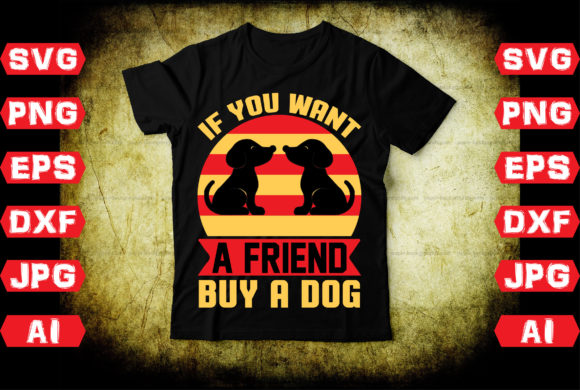
If You Want a Friend, Buy a Dog
As someone who’s stitched hundreds of designs across apparel, home goods, and personalized gifts—from boutique baby onesies to Etsy best-selling tote bags—I opened If You Want a Friend, Buy a Dog expecting charm, but what stood out immediately was its quiet confidence. It’s not loud or overly stylized. No cartoonish paws, no exaggerated fonts. Just clean, warm, hand-drawn lettering with subtle organic weight—like something you’d see embroidered on a linen tea towel in a thoughtful gift shop, or stitched onto the chest of a soft cotton sweatshirt for a dog-loving teacher.
This isn’t just another T-Shirt Designs graphic—it’s a personality anchor. The phrase carries emotional resonance, and the execution supports it: balanced spacing, gentle curve to the baseline, and just enough variation in stroke thickness to feel handmade without sacrificing legibility. That matters deeply when translating into machine embroidery design. I’ve seen too many “cute” phrases fall apart under satin stitch or vanish on textured fabric. If You Want a Friend, Buy a Dog avoids that trap by prioritizing clarity over cuteness.
Where This Design Actually Shines (and Why)
I tested it first on a medium-weight cotton canvas tote—my go-to for craft fair samples—and then on a brushed French terry sweatshirt. On both, the design held up beautifully. The letterforms translated cleanly into fill stitch and satin stitch without overcrowding. No dense clusters of thread, no fragile serifs collapsing mid-stitch. It’s sized right for a 4"–5" hoop—ideal for chest placements, pocket accents, or center-front embroidery on baby rompers.
It’s especially strong for products where tone and intention matter more than trend: nursery decor, pet memorial gifts, vet clinic merchandise, or small-batch aprons for dog-friendly bakeries. One real case I ran last week? A custom order for a local rescue’s volunteer appreciation bundle—embroidered on organic cotton pillow covers and matching tea towels. If You Want a Friend, Buy a Dog became the unifying motif. Customers didn’t just recognize it—they paused, smiled, and asked where to buy more. That kind of emotional response is rare—and valuable—for any craft business or Etsy seller.
Where to Use It Thoughtfully (Not Just Everywhere)
Don’t force this into tight spaces. While the SVG and DXF files give flexibility for resizing, the natural rhythm of the lettering means shrinking below ~3" starts to blur detail—especially the subtle taper on the “g” and “d.” Avoid it on curved surfaces like baseball caps unless you’re using a cap frame and have confirmed stitch stability in the crown curve. Also skip ultra-thin fabrics like voile or lightweight rayon without extra stabilizer—the open letter spacing leaves room for puckering if tension isn’t dialed in.
Dark fabric? Yes—but choose thread colors with intention. A warm charcoal gray or oatmeal works better than stark white on navy or black; it keeps the handmade product feeling grounded, not clinical. And while it reads well on textured fabrics like terry cloth or linen blends, avoid pairing it with highly napped surfaces (think heavy fleece) unless you’re willing to add a tear-away + cut-away stabilizer combo.
What It Adds to Your Finished Product—Beyond the Stitch
This design elevates perceived value without demanding premium pricing. Why? Because it looks intentional—not templated. When customers see If You Want a Friend, Buy a Dog on a hand-stitched patch or an embroidered kitchen towel, they don’t think “generic quote.” They think “this person chose this for me.” That builds trust. That supports brand consistency for small shop owners who want their aesthetic to feel curated, not crowded.
For digital product sellers, it’s a smart addition to a “Thoughtful Gifts” bundle—especially paired with minimalist dog silhouette graphics or paw-print borders. As a standalone embroidery file, it’s versatile enough for commercial embroidery use, but always confirm licensing before including in resale bundles or sublimation-ready mockups.
Practical Designer Notes Before You Stitch
- Test first—on scrap fabric matching your final project’s weight and stretch.
- Check thread color contrast in natural light—not just on screen. What looks bold in your embroidery software may soften after stitching.
- Review stitch density manually if converting from SVG/DXF to embroidery format. Some auto-digitizers overfill open areas; keep letter interiors breathable.
- Confirm hoop size compatibility before digitizing—you’ll likely land comfortably in a 5" x 7" hoop, but verify if working with smaller machines.
- Inspect small details at 200% zoom: the tail of the “y,” the crossbar of the “t,” and spacing between “a” and “F” should remain distinct.
- Mock it up in black and white—not just full color—to assess balance and visual weight.
- Compare light vs. dark backgrounds using printable mockups. Does it retain warmth on charcoal? Does it pop on cream?
- Use appropriate stabilizer: medium-weight cut-away for knits, tear-away for stable wovens, and fused + tear-away for textured linens.
- Verify usage rights before selling finished items or bundling the digital embroidery file—especially for Etsy listings or craft fair inventory.
At its core, If You Want a Friend, Buy a Dog isn’t about dogs—it’s about connection, comfort, and quiet sincerity. That’s why it works so well across baby embroidery, holiday embroidery, personalized gifts, and small shop merchandise. It doesn’t shout. It invites. And in a market flooded with flashy graphics and over-digitized clipart, that kind of restraint is a professional advantage.
Whether you’re prepping a batch of embroidered patches for a dog-walking co-op or building a cohesive line of nursery decor, this design earns its place—not because it’s trendy, but because it’s trustworthy, adaptable, and genuinely nice to stitch.